Portable Washing Machine for Apartments: The Connection That Leaks
Some links below are affiliate links. If you buy through them, this site earns a commission at no extra cost to you. Full disclosure.
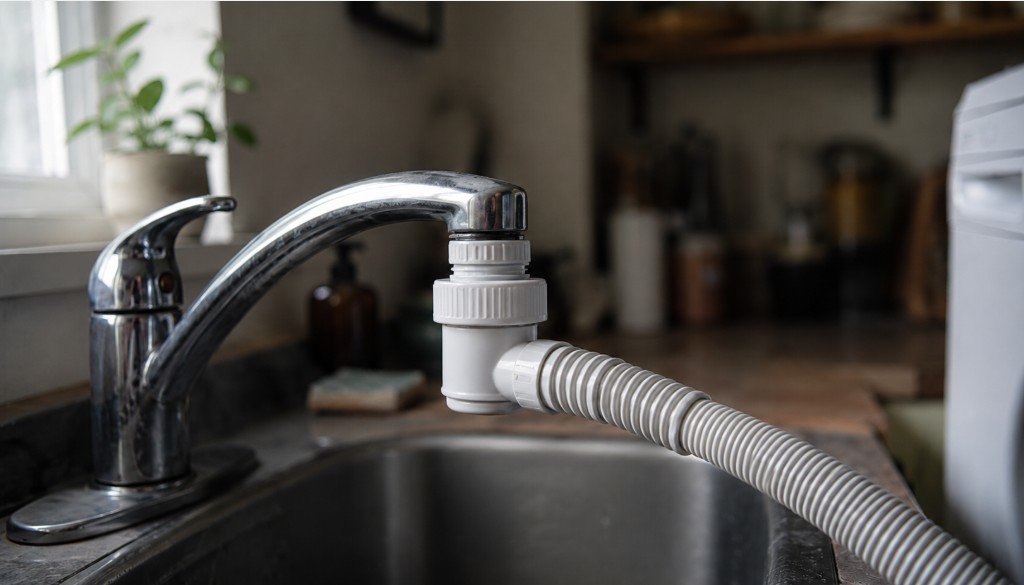
The call came in on a Tuesday, from the tenant in the unit below. Her kitchen ceiling had a brown ring in it about the size of a dinner plate, and it was still growing while we were on the phone. Upstairs, the tenant was at work. When I let myself in, the floor in front of the sink was dry — mostly. The washer sitting next to the sink was off, quiet, unremarkable. The drain hose had slipped out of the basin at some point and was resting on the counter edge, and the little plastic adapter screwed onto the faucet had a slow bead of water forming and falling, forming and falling. It had probably been doing that for two days.
Nobody had done anything reckless up there. That’s what stuck with me. A portable washing machine for apartments is one of the better ideas in renter life — laundry at home, nothing permanent, and it comes with you when the lease ends. But the risk isn’t where the review sites keep pointing.
What is a portable washing machine?
A portable washing machine is a compact washer that connects to a standard sink faucet with a threaded adapter instead of permanent plumbing hookups, and drains into the sink through a flexible hose. It plugs into a normal outlet, rolls on casters, and can be disconnected and stored between loads — which makes it one of the few laundry options available to renters in units without hookups.
Read that definition again and you’ve basically got the problem. The temporary faucet connection, the loose drain hose, the wheels: every feature that makes one of these renter-friendly is also a place water can get out.
The machine isn’t the risk. The connection is.
Read four or five roundups on these and they’re all measuring the same things: capacity in pounds, spin speed, decibels, energy draw. Those are fine numbers. They tell you how well the thing washes clothes. What they don’t tell you is what a portable washer can cost you at move-out, and that number doesn’t come from the drum at all. It comes from three connection points.
The faucet adapter. A molded plastic fitting, usually included in the box, that screws on where the aerator was. It sits under city water pressure whenever the tap’s open. It gets threaded and unthreaded over and over, and it’s always wet. It’s also the cheapest thing in the setup. I’d look at yours before you spend money anywhere else.
The drain hose. It doesn’t attach to anything. You hook it over the lip of the sink and that’s the entire retention system. That works fine until the machine moves, or someone bumps it, or the hose warms up and decides to hold a different shape.
The machine itself. Load it unevenly and the spin cycle will walk it across a smooth floor. I’ve seen one end up eighteen inches from where it started. The hose and the supply line either come along or they don’t.
This matters more to me than spin speed does, and the reason isn’t complicated. A scuff on a wall stays in your apartment. Water doesn’t. It goes down, so one leak becomes two units, and the downstairs neighbor’s furniture is suddenly part of the conversation. Ceiling stains also stay visible after they dry, and if paint won’t cover the ring, the drywall comes out. It’s one of the few kinds of damage that can eat a whole deposit rather than a slice of one.
And the timing surprises people
Most of the water damage I saw didn’t happen mid-cycle. It happened when nobody was home. The machine isn’t even running — you’re at work, the tap is still open, and that little adapter is sitting under pressure for hours. Nine of them, some days. That’s a lot to ask from a five-dollar plastic adapter.
So turn the tap off after every load. Three seconds, and it takes the worst version of this off the table. I’ll repeat it further down, because it’s the step people skip.
The three-minute check to run before you buy
Before you compare models, find out whether your apartment can take one at all. Three minutes. It has saved people a return shipping fee more than once.
Your apartment’s fit test
- Does the tip of your faucet unscrew? The adapter replaces the aerator — the little screen at the end of the spout. On a lot of newer kitchen faucets, especially pull-down sprayer heads and touch-activated models, that piece either doesn’t come off or isn’t a standard thread. Try it with your fingers now. If it won’t budge, or the threading looks proprietary, a portable washer won’t work at that sink. You’ll want to know that before the box shows up.
- Will your sink hold the drain hose? The hose hooks over the basin edge. Very thick counters, very shallow bar sinks, and deep farmhouse basins all cause trouble in different ways. Then ask whether you can live without that sink for a full cycle, since you can’t really use it while the machine’s draining.
- What’s the floor? Tile forgives. A small leak gets wiped up and forgotten. On laminate or engineered wood the same leak swells the seams, and that doesn’t reverse — the board stays raised after it dries. This one thing changes your risk level more than the machine you pick does.
- Is anyone below you? Ground floor and third floor are genuinely different situations. Downstairs, a bad night is a mopping job. Above someone else, it’s two apartments and an insurance claim.
The rule I’d apply: wood or laminate floor plus an upstairs unit means no full-size machine. Go smaller, and use a tray — don’t talk yourself out of the tray. If neither appeals, the laundromat for one more lease is a perfectly reasonable answer, even if it’s not the one you wanted.
Comparing portable washers by deposit risk, not by capacity
| Option | Rough cost | Deposit Risk | Best for |
|---|---|---|---|
| Drip tray / leak pan | $25–$50 | Low | Everyone, before anything else |
| Compact single-tub portable washer | $250–$330 | Moderate | Small loads, tile or vinyl floors |
| Twin-tub manual washer | $130–$220 | Moderate | Renters who want no permanent connection |
| Full-size ventless washer-dryer combo | $700–$1,200 | High | Not what I’d put in a rental |
| Replacement faucet adapter | $12–$25 | Low | Anyone whose included adapter feels flimsy |
| Water leak sensor (3-pack) | $30–$55 | Low | Anyone on an upper floor |
Do portable washing machines damage apartments?
The machine rarely causes damage on its own. Damage comes from the temporary faucet adapter leaking under pressure, the unsecured drain hose slipping out of the sink, or an unbalanced spin cycle moving the machine and pulling on both lines. Leaks are most likely when the unit is idle but still connected to an open tap, and the resulting floor and ceiling damage is the most expensive category of deposit deduction.
Six things to consider, ranked by how much they protect you
A drip tray under the machine
Yes, I’m opening a washing machine article with a plastic tray. It’s deliberate. The tray sits under the washer and holds a slow drip for hours instead of letting it reach the floor, which turns “the laminate swelled” into “there’s water in the pan.” The point is just to catch a leak before it reaches the floor.
Get one with a raised lip, and big enough that the machine can shift a few inches and still be inside it. Some pans include a drain fitting. That’s only useful if you actually have somewhere to route it, and in most apartments you won’t — so don’t pay extra for the drain feature alone. An unused fitting comes with a plug; leave it in.
Manufacturers list a gallon capacity for these pans. Treat that as a ceiling in perfect conditions, not a promise — a pan on a slightly out-of-level floor holds less than the label says, and most apartment floors are slightly out of level.
Compact single-tub portable washer
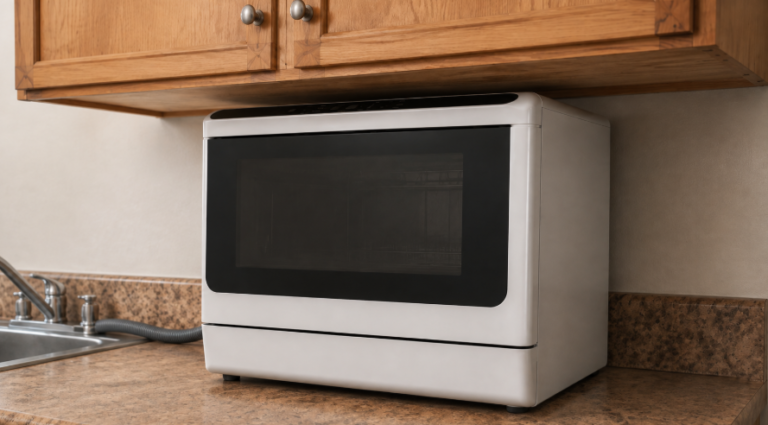
The category default. A single drum on rollers, roughly the footprint of a two-drawer file cabinet, with a quick-connect adapter for the faucet and a hose that hooks into the sink. You load it, it fills and washes and drains, then you wheel it back into the closet. For one person it handles everyday laundry fine.
Capacity is where I’d slow down. Six and a half pounds is a small load — a few shirts, some underwear, a pair of jeans and you’re done. Larger portables exist, but the bigger the drum, the more of it you’re going to fill, and a crowded drum is what sets the machine walking. I’d rather run two small loads than watch a big one travel across the kitchen. Think about that before you order, because if you pictured two loads a week and the real number is four, that changes the appeal.
One spec I’d check on any listing: unbalanced-load detection. Better models pause and redistribute. Cheaper ones spin harder and hope. This one has it, which is most of why it’s the model here rather than its bigger siblings.
The 6.6 lb figure is the rated maximum, not a target. The load that matters is the one where the spin stays quiet, and that’s usually a bit under the rating. Unit weight is about 44 lb, so one person can move it — awkwardly.
Twin-tub manual washer
Two chambers side by side — one washes, one spins — and you move the clothes across yourself. More hands-on than people expect. You’re lifting soaked fabric from one tub to the other, and that’s heavier and messier than it sounds on paper.
It’s here anyway because it doesn’t stay connected. You fill it, run it, drain it, done. Nothing lives on your faucet the rest of the day, so the failure point I just spent six hundred words on isn’t sitting there while you’re at work. It’s cheaper, too. Upstairs on wood floors, this is the one I’d point you at first.
One tradeoff is that filling is manual. On this style of twin tub you don’t turn the faucet on and walk away — you stay with it and shut the water off yourself. Inconvenient. It also means the machine isn’t quietly holding a pressurized faucet connection all day.
It does splash, though. Open tops, and the transfer between tubs drips. Another reason for the tray.
Spin-cycle drying claims on twin tubs vary wildly between listings for what looks like the same unit. I’d assume clothes come out damp enough to need a drying rack, not “nearly dry.”
Full-size ventless washer-dryer combo
These are marketed straight at renters, and I get the appeal. One box washes and dries, no vent, no duct through an exterior wall, “apartment friendly” right there in the listing. A few things keep me from linking one.
Start with weight. These are full-depth machines and full of water they’re heavy in a way a compact unit isn’t. An unbalanced one doesn’t tap the wall, it shoves. On laminate and vinyl plank the feet leave compression marks that are still there after the machine leaves, and those don’t buff out the way a scuff does.
Then the drying, and I want to be careful here because this gets described sloppily all over the internet, including by me until fairly recently. A ventless machine doesn’t dump your laundry’s moisture into the room. It condenses that water and sends it to a drain hose or to a tank you empty by hand. What it does put into the room is heat, plus some humidity depending on the design — condenser models pull room air through to cool the wet air, and they’re generally understood to raise humidity more than heat-pump models do. In a studio in February with the windows shut, that’s not nothing.
The tank bothers me more than the humidity does. It fills every cycle, it’s tucked into a machine you have to slide out to service, and it gets carried across the room by somebody in a hurry. Small spills, same spot, over and over, in the place you can’t see. Damp baseboards and window edges are where mold arguments start at move-out — the same condensation problem I got into in the window film article — and “the appliance did it” doesn’t help much when the appliance was yours.
And then the money. Seven hundred to twelve hundred dollars for something you’ll have to carry down a staircase and then hope fits the faucet at the next place. I’d rather you spent two hundred of that on the compact machine and kept the rest.
No affiliate link on this one — I don’t want to earn a commission on a purchase I’ve just spent four paragraphs arguing against.
A better faucet adapter than the one in the box
Unscrew the adapter that came with your machine and hold it in your hand. Hollow plastic, fine threads, and it’s expected to seal against city water pressure for a couple of years while being screwed on and off a few hundred times. A brass one with a proper rubber washer costs about what lunch costs.
Get the thread size right. Check the aerator you took off: on US kitchen faucets it’s usually 15/16″-27 when the threads are on the outside of the spout, 55/64″-27 when they’re recessed inside. Smaller junior sizes and metric threads are out there too, so this isn’t a guess you want to make from a photo. Plumbers do it with pocket change — a quarter just covers the regular male thread. Buy two while you’re at it. The spare should be in a drawer, not on order the week after the leak.
Listings that say “universal” usually mean it ships with three plastic rings. Sometimes one fits. Measure first.
A water leak sensor on the floor
Sits in the tray, screams when it gets wet, and pings your phone while you’re at the office — which is exactly when the leak at the top of this page was happening. Put one in the tray and one behind the machine where the floor meets the wall. Three-packs are normal, so the spare goes under the kitchen sink.
Check your router before you order. The gateway won’t join a 5 GHz network, and plenty of apartment routers are set up that way.
Battery life claims of two or three years assume the sensor never triggers and never sits in a humid spot. Behind a washer is a humid spot.
In five years of inspections, I never once deducted for a portable washer. I deducted plenty for what happened around one.
Setting it up so it doesn’t cost you anything
- Photograph the faucet and the floor before you touch anything. Under the sink, too. If you’ve already got a move-in photo record, add these to it. The whole point of that record is that a stain you find two years from now can be dated.
- Photograph the aerator before it comes off, then bag it. That screen goes back on when you leave, and you won’t remember which one it was. Tape the bag inside a kitchen cabinet.
- Hand-tighten the adapter and stop. Plastic threads strip quietly, and a stripped adapter can chew up the spout itself. At that point it’s a fixture repair, not your-equipment problem. Snug, then a quarter turn.
- Secure the drain hose. Don’t just drape it over the edge. A zip tie or a clip anchoring it to the faucet neck or a cabinet handle takes a minute and kills the most common leak in the category.
- Tray first, machine second. Before the first fill, check the pan is under all four feet — not roughly under the middle of the thing.
- Stay in the room for the first full cycle. The first spin is when you find out whether the adapter holds and whether the machine walks. Costs you one afternoon.
- Balance the load, and don’t shove it against the wall. Contact during spin marks the paint, and a wedged machine can’t self-correct anyway. Leave a few inches and level the feet.
- Close the tap after every single load. Every load. You do not want that adapter holding pressure overnight.
- If you’re running a ventless dry cycle, crack a window or run a dehumidifier during and for a while after. Also empty the condensate tank over the sink, not while walking across the room.
- On move-out day: put the aerator back, lift the tray, dry everything underneath. Then photograph the floor under the machine and the wall behind it. Photograph the cabinet under the sink as well — that’s where the slow drips you never noticed show up.
Who should buy what
My rule for portable washers
A portable washing machine for apartments is a reasonable buy for most renters. Most problems don’t start inside the washer. They start at the faucet or the drain hose, and those are cheap to protect: a tray, a secured hose, a decent adapter. Add a sensor and the habit of closing the tap and the whole defense runs under a hundred and fifty dollars, against a machine that costs about three hundred and a water event that costs considerably more than either.
Before any of that, check whether your aerator comes off. Not every sink will take one. It takes two minutes to find out, and it’s worth doing before you order.
I still think about that Tuesday call. Not the ceiling — that got cut out and replaced in an afternoon — but the conversation afterward. The tenant upstairs was mortified. She’d been careful about everything else in that apartment: felt pads under the furniture, asked before she hung anything on the walls. She got the hard parts right and lost her deposit on a plastic fitting she’d never once thought about. Nothing in the box, and nothing she’d read, had suggested she should.
Buy the machine if your sink and your floor can take it — most can. Then spend another fifty dollars making sure it can’t do anything quietly while you’re at work.
And document the space before you install anything. Here’s how I’d photograph a rental so the record still means something two years later.
Disclosure: SaveTheDeposit.com participates in the Amazon Services LLC Associates Program. Purchases made through links on this page may earn the site a commission at no additional cost to you. Products are selected on merit; the rejected option above carries no link.
About the author: Dana Whitfield spent five years managing apartment communities in Ohio and North Carolina, where she ran move-out inspections and calculated deposit deductions. She now rents, and writes about improving a rental without paying for it at the end of the lease. Nothing here is legal advice — lease terms and local rules vary, and your landlord’s expectations are the ones that count.