Dehumidifier for Apartment: The Closet It Never Reaches
SaveTheDeposit participates in the Amazon Associates Program. If you buy through a link here, we may earn a commission at no extra cost to you. Products are chosen for how they affect your deposit, not for commission rate.
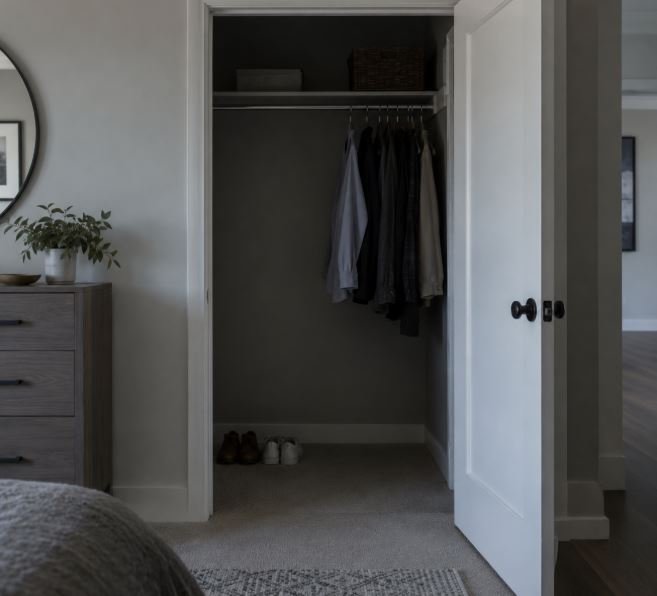
There’s a version of the damp-apartment story that turns up again and again on move-out deduction lists. The living room is fine — dry baseboards, clean corners, nothing on the ceiling. Then someone opens the bedroom closet, pushes the hanging clothes aside, and the back panel has gone gray-green in a band where the closet backs onto an exterior wall. In plenty of those units, there was a dehumidifier running the whole time. It was in the living room, twenty feet from the only surface that was actually failing.
A dehumidifier for apartment living is a genuinely useful thing to own. But it dries the air in a room, and the damage that costs renters money doesn’t happen in the air of a room. It happens where air doesn’t move — behind furniture, inside closets, along the base of the coldest wall in the unit.
What a dehumidifier for apartment use actually does
A dehumidifier pulls room air across a cold coil, condenses the moisture out of it as liquid water, collects that water in a tank or routes it out through a hose, and returns warmer dry air to the room. It doesn’t remove moisture from the building. It moves moisture from the air into a container that has to be emptied, which means its usefulness depends on where it sits and how reliably that container gets dealt with.
Two families of machine do this. Compressor units work like a small refrigerator and handle real rooms. Thermoelectric units use a Peltier plate, draw very little power, and pull a fraction as much water — more on those below, because they dominate the search results and they’re the wrong buy for most renters.
Capacity gets quoted in pints per day, and that number deserves suspicion. It’s measured in a test chamber, not a bedroom, and the testing standard changed a few years back — the same physical machine has been sold as a 50-pint unit and a 30-pint unit depending on which standard a listing quotes. Neither figure describes what it’ll pull in a cold back bedroom in November, which is lower than both. Read the number as a rough size class.
The water has to go somewhere
Three things go wrong, and none of them involve the machine breaking.
The tank fills and the unit shuts off
Every consumer dehumidifier stops when its reservoir is full. In a damp apartment that takes eight to twelve hours. It runs while you’re at work, fills sometime in the afternoon, shuts off, and the humidity climbs back through the evening and overnight. You come home, the room feels heavy, and the easy conclusion is that the unit isn’t strong enough. Usually it’s fine. It just spent two-thirds of the day switched off.
What makes this expensive rather than annoying is the direction of the failure. Elsewhere on this site the problem is a device doing something to your apartment. Here the harm accrues during the hours the machine is idle — and it accrues under the assumption that the problem is handled, which is why the closet stops getting opened and the bed stops getting moved.
The unit is shoved against the wall
Most of these machines take air in from the back or side and exhaust warm dry air from the top. Pushed flat against a wall, a unit recirculates its own output and efficiency drops. That’s the manufacturer’s concern. The deposit concern is underneath it. A dehumidifier is a cold object standing on your floor, and cold objects in humid rooms collect condensation on their own surfaces. Set one directly on carpet or laminate and a thin film works its way into the pad or the seams between planks. Nobody moves the machine for six months, and when it finally gets moved there’s a rectangle.
Emptying it
A full tank holds a few liters and it sloshes. It gets carried from the bedroom, down the hall, past the rug, to the bathroom sink, and it drips — most times only a little. Same route, same handoff at the doorway, three times a week for a year. Carpet damage at move-out rarely looks like an accident. It looks like a path, and a path is much harder to argue was a one-time spill.
The part nobody plans for: the machine never sees the worst surface
Mold grows on cold surfaces where air is still, and a dehumidifier only treats air that reaches it. Inside a closed closet, behind a headboard against an exterior wall, in the eight inches behind a dresser — that air doesn’t circulate into the room, so it doesn’t get dried. The unit lowers the room’s average, which feels like progress and reads well on a meter, while the coldest and stillest square foot in the apartment sits at a completely different number.
A unit can run for two years, hold the room at 45% the whole time, and the closet still comes back stained. That isn’t a product failure. It’s a mismatch between what the machine does and where the risk is.
Worth saying plainly: from the outside, the line between damp a tenant caused and damp that came with the building is genuinely hard to draw. Ventilation habits matter. So does a north-facing wall with poor insulation, which no habit changes. Deduction disputes over mold rarely get settled by working out which one it was — they get settled by whoever has dated photographs from the start of the tenancy.
Before you buy anything: the worst-spot test
One evening, and it decides whether a dehumidifier is the right purchase at all — and if so, which room it belongs in.
- Touch the walls. Flat palm on an interior wall, then an exterior wall in the same room. A temperature difference you can feel without concentrating marks the surface where condensation forms.
- Pull the furniture out and look behind it. Wardrobe, headboard, sofa, dresser — anything backing onto an exterior wall. Damage starts on the wall side and the furniture side at once, and both stay invisible until you move it.
- Leave the closet doors open overnight, then smell it in the morning. Crude, but with no meter in the house it’s the earliest reliable signal available. A closet that smells different from the room is telling you something the room isn’t.
- Ask where the moisture comes from. Showers with a weak fan, laundry drying indoors, cooking without extraction — internal sources, and a dehumidifier genuinely fixes those. Cold exterior walls, a slab floor, thin insulation — structural, and a machine manages the symptom without touching the cause.
The rule this gives you: moisture confined to one room and traceable to something you do inside the apartment means buy the machine and put it in that room. Moisture in more than one room, concentrated along exterior walls, means the machine is symptom management — still worth owning, no longer the priority. The priority is documentation, and it should start on day one. Our move-in inspection checklist covers what to photograph and how to timestamp it.
Where the moisture is vs. what to do about it
| What you found | Likely source | What a dehumidifier does | Deposit priority |
|---|---|---|---|
| One room, worse after showers or indoor drying | Internal | Solves it | Buy the unit, size it to that room |
| Closet interior only, room reads normal | Still air on a cold surface | Little to nothing | Absorber inside the closet + circulation |
| Band of staining along one exterior wall | Structural | Manages, doesn’t cure | Photograph first, then buy |
| Multiple rooms, worse in winter | Building envelope | Manages, doesn’t cure | Documentation, dated |
| Under or behind an appliance | Appliance output | Partial | Fix the placement first — see our portable dishwasher guide |
Do dehumidifiers prevent mold in apartments?
Only where their air reaches. A dehumidifier holds the open air of a room at a lower humidity, which suppresses surface growth on exposed walls and furniture in that room. It has effectively no influence inside closed closets, behind furniture flush to an exterior wall, or in a second room with the door shut — the places where staining usually starts. Pair the unit with circulation in those spots, or it treats the space that was never at risk.
What to buy
1. Compact compressor dehumidifier, 20–30 pint class
This is the category’s real answer. A compressor unit in this size class handles one to two rooms of a normal apartment: it pulls meaningful volumes of water, keeps working when the room drops into the low sixties, and runs a fan hard enough to move air across a space rather than the two feet in front of it.
The trade is noise and footprint. It’s a small appliance, not a gadget — roughly nightstand-sized, with a compressor cycling on and off within earshot. Stand it on a hard surface with clearance on every side, out toward the open floor rather than tucked into a corner, since a corner is where you want air pulled from rather than where the intake should sit.
- Type
- Compressor / refrigerant
- Coverage
- One to two rooms
- Tank
- Typically 3–5 L, auto shutoff when full
- Drain
- Check for a hose port before buying
- Placement
- Hard floor, clearance all sides
Spec note: pint ratings in this class are quoted under two different test standards, so a “30 pint” and a “50 pint” listing may describe identical hardware. Compare tank volume and physical dimensions instead.
2. A model with a continuous drain port
This is the feature that turns a dehumidifier from something you maintain into something that runs. A drain port takes a length of hose and lets condensate run out continuously, so the tank never fills and the unit never shuts itself off — the idle-hours problem disappears with no effort from you.
Gravity does the work, which is the constraint. The hose has to run downhill into a floor drain, a tub, or a sink, so the unit needs to sit higher than the drain and the hose has to lie where it won’t be kicked. Nothing gets connected to plumbing and nothing gets modified. If the run would cross a doorway or a walkway, skip it and empty the tank on a schedule instead. Plenty of units ship with the port and no hose, so check.
- Key feature
- Gravity drain outlet
- Hose
- Often sold separately
- Requirement
- Drain lower than unit, unobstructed run
- Best for
- Bathrooms, laundry nooks, rooms with a floor drain
3. Renewable moisture absorber for the closet
Hang or set one inside the closet the big machine can’t reach. No power, no tank, no noise — silica beads that saturate, change color, and get dried out for reuse. Two or three cost less than a takeaway meal, and they sit exactly where staining starts.
- Type
- Rechargeable desiccant
- Power
- None in place
- Coverage
- Closet, wardrobe, cabinet interior
- Cycle
- Weeks, then dry and reuse
4. A tray to stand it on
Lift a unit that’s been in the same spot for eight months and there’s often a mark under it: condensation off the machine’s own housing, plus whatever escaped during tank changes, working into carpet pad or laminate seams. A shallow waterproof tray with a raised lip catches both.
Get a lip rather than a flat mat — flat spreads a spill sideways instead of holding it. Size it wider than the unit’s base so tank removal happens over the tray, and lift the tray to check under it whenever you’re moving the machine anyway.
- Shape
- Raised lip, not flat
- Sizing
- Wider than the appliance footprint
- Material
- Verify listed material against the photos
- Also protects against
- Spills during tank removal
5. Peltier / thermoelectric mini dehumidifiers
The appeal is obvious. Thirty or forty dollars, silent, the size of a lunchbox, filling the first page of results, with review sections full of people photographing a full tank after a couple of days. That photograph is the most persuasive thing about the product and also the most misleading.
A thermoelectric unit collects a few hundred millilitres a day in good conditions. It will fill its small tank and it will not change the humidity of a bedroom. The risk for a renter is specific: buy one, see water in it, conclude the moisture is handled, and spend two years taking no photographs and moving no furniture. A full tank proves the air had moisture in it, not that the air stopped having moisture in it. For a room, option 1 above is the one to look at; for a closet, option 3 costs a tenth as much and is aimed at the right place.
6. A basic hygrometer — buy several
Buy the cheap kind, in a multipack, with a screen and no app. One number for the apartment is a fiction, and one meter can’t disprove it. Put one in the living room, one in the bedroom, one on the closet floor behind the shoes.
The closet reading is the one that surprises people. Room at 48% and closet at 68% locates the problem before it becomes a stain, and gives you something specific to point at instead of a general impression that the place feels damp.
- Buy as
- Multipack, three or more
- Display
- On-device, no app required
- Placement
- Room, closet floor, behind furniture
- Watch for
- Units drifting apart — cross-check them side by side first
Living with one without creating a second problem
- Photograph the vulnerable surfaces before the machine arrives. Closet backs, the wall behind the wardrobe, the base of the exterior wall. First, because a photo taken after you started managing the problem proves much less.
- Give it clearance. Away from the wall, away from furniture. It needs to pull air from across the room, not from the six inches around itself.
- Empty it before it’s full, on a schedule. Pick a fixed time and empty it then, full or not. A machine that never reaches shutoff never has the idle gap.
- Choose the emptying route deliberately. Hard floors, no rugs, shortest distance, tank carried level and low. Take the long way around if the short way crosses carpet.
- Look under it every few weeks. Tilt it, hand flat on the floor underneath, check the tray.
- Open the closed doors regularly. Closets, wardrobes, the spare room. An hour with the doors open lets the unit reach air that’s otherwise sealed off from it.
- Take one photograph a month, same spot, same angle, timestamped. Staining develops too slowly to argue about from memory, and a monthly sequence is the only thing that shows a surface either changing or holding steady across a tenancy.
- Photograph again at move-out — the spot the unit stood on, the base of the exterior wall, and inside every closet, before furniture goes back or the room gets cleaned.
Enough capacity to matter in a real room
Removes the idle-tank gap
Sits where the machine can’t reach
Protects the floor under the unit
Fills a tank, not a room
Tells you which room to spend on
If the moisture came with the apartment, the machine is not your defense — the record is. Structural damp doesn’t stop because an appliance arrived, and at move-out the conversation won’t be about what equipment was in the room. It’ll be about what the unit looked like on day one. If you’re moving in now, start with the move-in inspection checklist and photograph closet interiors and exterior wall bases before a single box goes in.
Back to that closet
In the version of the story that opens this article, the tenant had done more than most renters do — noticed the apartment was damp, spent real money on a machine, ran it faithfully. The deduction landed anyway, and not because the machine was bad. It was in the wrong room, and there was nothing on file from move-in to compare the closet against.
Buy the dehumidifier. Put it in the room the test points you to. Then open every closed door in the apartment and take the photographs the machine can’t take for you.
Affiliate disclosure: SaveTheDeposit is a participant in the Amazon Services LLC Associates Program, an affiliate advertising program designed to provide a means for sites to earn advertising fees by advertising and linking to Amazon.com. Prices and availability are accurate as of the date of publication and are subject to change.
About the author: Dana Whitfield writes SaveTheDeposit from a property-management perspective, focusing on the gap between what renters are told will cost them at move-out and what actually does. Scenarios described here are composites drawn from common inspection findings, not accounts of specific tenancies.