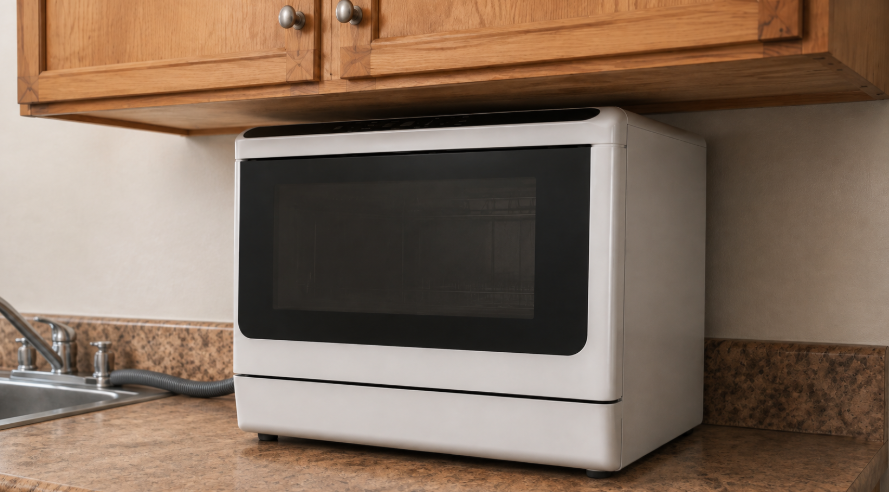
Portable Dishwasher for Renters: The Cabinet Above It Is the Problem
SaveTheDeposit is reader-supported. Some links below are affiliate links. Full disclosure.
The unit had been spotless. Renter of three years, kitchen wiped down, floors better than the day she moved in, and I was already mentally signing off on the full refund when I opened the cabinet over the counter to check the shelf pins. The underside of that cabinet — the flat panel you look up at when the door swings open — had gone soft and wavy near the front edge. The laminate had lifted away from the particleboard in a bubble about the size of my hand. Nothing above it. No pipe, no leak, no stain running down the wall.
She had no idea it was there. Neither did I, until I looked up.
A portable dishwasher for renters is one of the few appliances that can do that kind of damage without ever spilling a drop. The washing machine version of this problem is about water going where it shouldn’t. This one is about heat and vapor going exactly where the manufacturer intended, into a cabinet that was never built for it.
What is a portable dishwasher?
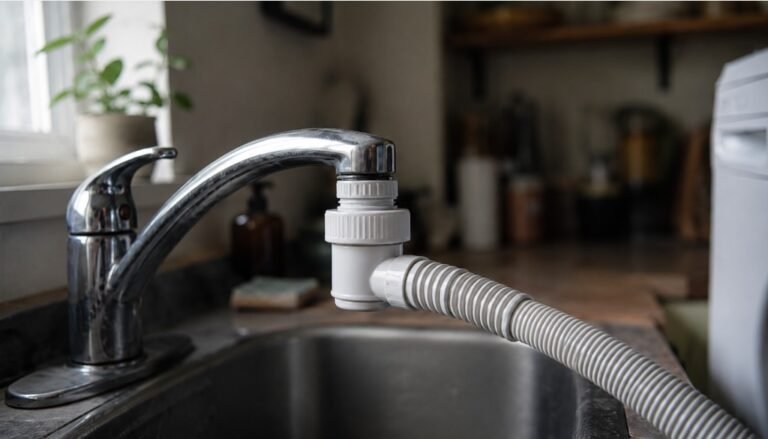
A portable dishwasher is a freestanding dishwasher that requires no plumbing installation. It connects to a kitchen faucet with a quick-release adapter and drains into the sink. Countertop models sit on the counter and hold roughly four to six place settings; full-size portable models roll on casters and stand on the floor. Both run on a standard household outlet.
That definition covers two machines that look related on a product page and behave completely differently in a rented kitchen. One lives on your counter, under your cabinets, at face height. The other rolls into a corner and never touches a surface you’ll be charged for. The gap between them is most of this article.
The steam is the part nobody prices in
Here is what a dishwasher does at the end of a cycle: it heats the interior, and then it has to get rid of the moisture. Condensing models cool it against the stainless tub and send it out with the drain water. Cheaper countertop units vent it — warm, wet air leaving through a slot or around the door seal, rising, because warm wet air always rises.
Put that machine directly under an upper cabinet and you’ve built a small, repeating humidity chamber. Not enough to notice on any single day. The cabinet underside gets warm and slightly damp for twenty minutes, then dries out. Then it happens again the next night, and the night after that, for two years.
Particleboard with a thin laminate or melamine face doesn’t handle that gracefully. Water vapor works into the edges and the seams, the board swells, and the laminate loses its grip and lifts. Once it swells it does not go back down — sanding it flat just removes more of the surface, and there’s no refinishing a substrate that’s already expanded. Property managers replace the panel. Panels get charged to the deposit.
The reason this catches people is that there’s no event. A leak announces itself; you see the puddle, you grab a towel, you know something happened. Steam damage accumulates in a place you only look at when you’re reaching for a glass, and even then you’re looking at the shelf, not the ceiling of the cabinet.
Auto-open doors: a real feature with a real cost
Several models now pop the door open a few inches when the cycle ends. It genuinely works — dishes come out drier, and you’re not left with puddles in the bottom of upturned mugs. What it also does is dump the whole moisture load into the room in an uncontrolled way, at exactly the moment the interior is hottest, usually while you’re in another room and not thinking about it.
So the feature is both the fix and the problem, depending on what’s eight inches above the machine. If there’s open air over it, auto-open is a good thing and I’d pay for it. Under a cabinet, it’s the worst version of the situation.
The counter edge, and the gap behind
The drain hose has to get from the machine to the sink, which means it crosses the front or side edge of your countertop. Laminate counters are weakest exactly there — at the edge banding and at the cut line around the sink, where the substrate is only protected by a strip of glued-on trim. Water tracks along the hose, sits on that edge, wicks under the banding. Same failure as the cabinet, different surface.
And then there’s the space between the back of the machine and the wall. Condensation collects there, the wall behind it stays damp, and nobody moves a dishwasher to look. If you’ve read the portable washing machine piece, this is the countertop version of the behind-the-machine problem I raised there.
The faucet adapter is a weak point in both setups, and I covered it in detail in that article rather than repeating it here — the short version is that it’s a plastic-to-metal threaded joint under pressure, and it fails without warning.
Weight, and the thing I genuinely don’t know
A loaded countertop unit isn’t light. The counter will hold it, that’s not the concern. The concern is what happens when you slide it — because if it lives on the counter only when it’s running, you’ll be moving it two or three times a week, and a machine dragged across laminate leaves scratches that cannot be touched up. Laminate has no depth to sand into. The pattern is printed on the surface.
What I can’t tell you is how much steam exposure a specific cabinet can absorb before it swells, because I’ve never seen anyone measure it, and I suspect it varies enormously by unit. A 2019 build with sealed melamine and a decent range hood pulling air out of the kitchen is not the same as a 1970s cabinet box with a raw particleboard bottom and a recirculating fan. I’ve seen the swollen version maybe a dozen times across two states, and I couldn’t tell you which of those kitchens had a dishwasher under the cabinet and which just had a kettle in the wrong spot. So treat the risk as real but unquantified, and treat clearance as cheap insurance rather than a formula.
The counter placement test — do this before you order anything
- How many inches from countertop to the bottom of the upper cabinet? You need the machine’s height, plus room for the door or lid to open, plus air above it. Write the number down. Most listings bury height in the spec table and lead with width, which is the dimension that matters least here.
- Does your faucet aerator unscrew? Quick check, and if the answer is no, the whole category is closed to you. I went through the aerator and adapter details here — same test, same answer.
- What is your countertop actually made of? Laminate, solid surface, or stone. This single answer changes your risk level more than anything about the machine. Granite and quartz do not care about a wet hose. Laminate cares a great deal, and it cares most at the edge banding and the sink cutout.
- Where does it live when it’s not running? The question almost nobody asks before buying. If it stays on the counter permanently, it takes something like half your usable prep space in a small kitchen. If it goes in a cupboard between uses, is it light enough that you’ll actually lift it — every time, for two years — instead of sliding it?
Do countertop dishwashers damage cabinets?
They can, indirectly. Countertop dishwashers vent warm, humid air at the end of the drying cycle, and that vapor rises into the underside of any cabinet mounted directly above. Repeated exposure swells particleboard and lifts laminate, which is not reversible. With eight to twelve inches of clearance and the door left open after each cycle, the risk drops sharply.
Comparing the options for a portable dishwasher for renters
| Option | Where it sits | Deposit risk | Best for |
|---|---|---|---|
| Standard countertop unit, tight cabinet above | Counter | High | Nobody in a rental |
| Full-size portable on casters | Floor | Moderate | Kitchens with 24″ of floor space |
| Compact countertop, open clearance | Counter | Moderate | Peninsulas, islands, no cabinet overhead |
| Counter heat/moisture barrier mat | Under machine | Low | Any laminate counter |
| Spare faucet adapter | Drawer | Low | Anyone mid-lease |
| Humidity sensor | Inside the cabinet | Low | Long leases, older cabinetry |
The picks
I’m starting with the one I’d tell you not to buy, because it’s the one you’ll see first everywhere else, and because the alternative right after it is genuinely good.
1. The standard countertop dishwasher, tucked under an upper cabinet
High riskMy objection isn’t to the machines. They’re cheap, they’re small, they wash dishes properly, and for a lot of apartments they’re the only realistic option. The objection is to the placement that the box photo teaches you — machine on the counter, cabinet a few inches above, which is where most renters put it because the counter run under the cabinets is the only counter they have.
Two years of drying cycles into that cabinet underside and the panel swells. You can’t fix a swollen panel, and you won’t see it coming, because the damage arrives in twenty-minute increments with a full recovery in between until suddenly there isn’t one. A spill on the floor gets wiped up. This gets replaced, and the replacement gets billed.
No affiliate link on this one, because the product isn’t the problem and sending you to buy it would be sending you to buy the placement. The next card is the version I’d actually put in a rental.
2. Full-size portable dishwasher on casters
Moderate riskThis is the recommendation. It stands on the floor, rolls to the sink when you run it, and rolls back against a wall when you’re done — and at no point in that sequence does it touch your countertop or breathe on your cabinets. The vent is at floor level under a butcher-block top, which means the steam goes into the room instead of into particleboard.
You give up floor space — an 18-inch machine plus room to roll it out, which is a genuine trade in a galley kitchen. The casters are also worth thinking about on old vinyl or soft flooring, where a heavy wheeled appliance rolled along the same track can leave marks. Keep it to one path and check underneath every few months.
Capacity is the payoff. These take actual pots. The countertop machines don’t, whatever the listing says about place settings.
Verify the height against your faucet — the top has to clear your sink lip when you connect it, and a tall unit at a low counter makes the hose sit at a bad angle.
3. Compact countertop model — where there’s real clearance
Moderate riskOpen the cabinet above your counter and look at the underside of it. If there’s nothing up there — you’re putting the machine on a peninsula, an island, a stretch of counter by the window, a rolling cart — then the entire argument in card one evaporates and a compact countertop unit is a sensible buy.
That’s the only difference between this pick and the rejected one. Same category of machine. Different eight inches of air. I’d still take the door open manually at the end of the cycle rather than letting it sit closed and sweat, and I’d still want a barrier under it.
Where these disappoint is capacity, and it’s worth being blunt: a manufacturer’s place-setting number counts plates, a bowl, a cup and flatware per setting. It does not count the skillet, the mixing bowl, or the chef’s knife that won’t lie flat. A “six place setting” machine handles dinner for two with cookware, not dinner for six.
Check whether the stated height includes the lid open or closed; several listings quote the closed figure only, and the difference can be six inches.
4. Silicone counter mat as a heat and moisture barrier
Low riskCheap, boring, and it takes the two failure modes I care about most off the table at once. It puts a waterproof layer between a warm wet appliance base and a laminate seam, and it stops the machine from being dragged directly across the surface. Get one larger than the machine’s footprint so it catches drips at the front edge too, and run it toward the sink side where the hose crosses.
Thin mats curl at the edges after a few weeks in a warm spot; thickness matters more than dimensions here.
5. A spare brass faucet adapter
Low riskThe adapter that ships in the box is the part that gets connected and disconnected most, and on most machines it is plastic threading onto metal every time. When it goes, it goes mid-cycle, and you will be dealing with pressurized water on a counter at nine at night with a machine you can’t stop cleanly. A five-dollar spare in the drawer converts that evening into an annoyance.
If the supplied plastic adapter fits your setup, buy a compatible brass replacement and keep it as the spare — brass threads survive repeated connect-and-disconnect cycles far better than molded plastic. Buy it after you’ve confirmed your threading, not before. These are not universal, and the one that matches your specific aerator is the only one worth owning.
Sellers list adapter sizing inconsistently — match the thread spec on your aerator, not the faucet brand.
6. A humidity sensor, inside the cabinet
Low riskIn the washing machine article I argued for a leak sensor on the floor, because there the danger is liquid arriving somewhere it shouldn’t. This is a different instrument for a different question: not whether water appeared, but whether a small enclosed space is staying damp longer than it should.
Stick one to the inside back wall of the cabinet directly above the machine and watch what the relative humidity does for a couple of weeks. If it spikes during a cycle and comes back down within an hour, your ventilation is fine and you can stop worrying. If it climbs and stays up, you’ve learned something you’d otherwise learn at move-out.
It joins your Wi-Fi directly, no hub, but 2.4 GHz only — which trips people up on newer routers that merge both bands under a single network name. Split them temporarily during setup if it refuses to connect.
Logs history and exports to CSV, which is what makes it useful as evidence rather than just an alert.
Setting it up without paying for it later
- Photograph the underside of the upper cabinet before the machine ever runs. Open the door, aim up, get the front edge and the corners in frame. This is the single most valuable thing in this article, and it costs you thirty seconds. Do the same for the counter edge where the hose will cross. The same documentation logic I use for move-in photos applies here — the photo is worthless unless you can find it in two years.
- Leave air above the machine. If the lid or door opens upward, it needs to clear, and it needs somewhere for the vapor to go that isn’t a flat panel four inches away.
- Open the door when the cycle ends and don’t walk away. Let the steam out on your terms, in the open, rather than letting it seep from a closed door for an hour into a confined space.
- Dry the counter edge after every run. Where the hose crosses is where the banding fails. One pass with a towel.
- Check behind the machine every few weeks. Condensation collects on the wall back there, and the wall is not something you can replace on your way out.
- Lift it, never slide it. If it’s too heavy to lift comfortably when empty, that’s information about whether this form factor works for you.
- Shut the faucet off after every use — the adapter is under pressure the whole time otherwise, and I’ve gone through why that matters in the washing machine piece.
- On the way out, photograph three things: the cabinet underside, the counter edge, and the wall behind where the machine stood. Compare to your day-one shots before the inspection, not during it.
Where each option lands
One measurement decides this
Countertop to cabinet underside, in inches, taken before you add anything to a cart. That number tells you whether you’re shopping for a countertop machine or a floor-standing one, and it’s the only spec in this entire category that your landlord’s cabinets care about.
Back to that cabinet
I never found out what caused the damage in that apartment. It might have been a dishwasher, it might have been a rice cooker, it might have been years of a kettle boiling in one particular spot. What stayed with me was how thoroughly invisible it had been to someone who cleaned that kitchen every week and cared about getting her money back.
She lost part of her deposit over a panel she had never once looked at. The rest of the apartment was immaculate. That’s the kind of loss that has nothing to do with being careless — she just didn’t know that surface was in play.
Now you do. Measure the gap, and put the machine where the steam has somewhere to go.
Disclosure: SaveTheDeposit participates in the Amazon Services LLC Associates Program. Some links in this article are affiliate links, and we may earn a commission on qualifying purchases at no additional cost to you. Products are selected on the basis of deposit risk to renters. Where a product category works against that goal, we say so and withhold the link. Nothing here is legal advice; deposit rules and lease terms vary, and your lease is the document that governs your situation.